
July 2021 CPSWFL Newsletter
Read Newsletter
July 2021 CPSWFL Newsletter Read More »

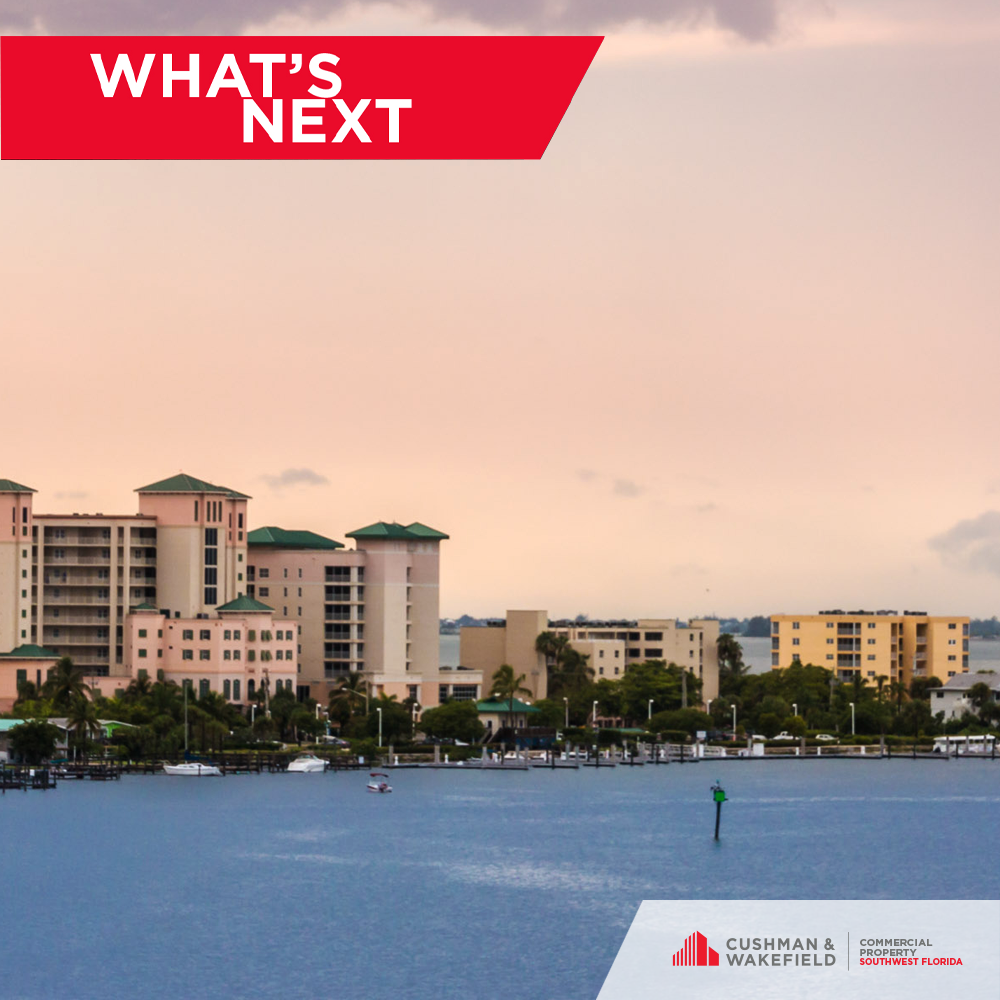
There’s no doubt that Southwest Florida is in growth mode. Commercial and residential properties in the region are selling at a record pace. Are we in a real estate bubble, or is this our new normal?
What’s Next, Ep. 24: Is this the “New Normal?” Read More »

FORT MYERS, Fla. (July 14, 2021) – After a record-setting second quarter of commercial real estate transactions, Cushman & Wakefield | Commercial Property Southwest Florida (CPSWFL) is expanding its executive team. CPSWFL is excited to announce the promotion of Lane Boy, CCIM to the role of Executive Director – Brokerage. A native-born Floridian, Boy has more than two decades of experience in real estate-related industries and joined CPSWFL in 2017. Before joining the CPSWFL team, Boy served as the CEO of two real estate businesses. Boy holds the distinguished Certified Commercial Investment Member (CCIM) designation from the CCIM Institute and is an expert in commercial properties of all types, specializing in land brokerage. He is also a member of Cushman & Wakefield’s National Land Practice Group. As Executive Director- Brokerage, Boy will serve on CPSWFL’s four-person leadership team, which guides the organization’s strategic initiatives and direction. He will also oversee brokerage education, training and reporting, and will set and benchmark broker goals. “Lane is more than just a consistent performer as a broker. He’s also an experienced leader,” said Gary Tasman, CEO and Principal Broker at CPSWFL. “His expert knowledge of Southwest Florida’s commercial real estate landscape and his leadership skills make him an outstanding model for our brokers to follow.” For more information about CPSWFL brokerage services, email Boy at lboy@cpswfl.com or visit www.cpswfl.com.

By Gary Tasman “Sustainability” has become one of the most common buzzwords in the business world, thanks to an evolving movement focusing on the triple bottom line: Profit, people, and planet. While the environmental impact of the way we conduct business shouldn’t be downplayed, the last year forced many businesses to double down on the first two “Ps” of sustainability: Profit and people. Social distancing and other precautions during the early months of the pandemic certainly created concerns about the long-term profitability of our local businesses, especially those in the hospitality industry. At the same time, the pandemic placed great strain on our people, who had to learn to work in new ways—or had to find ways to live without working—until restrictions were lifted. Despite the challenges, Southwest Florida has thrived. Our businesses—and by extension, our commercial property market—have sustained through the pandemic. I like to call this trend “Business Durability,” and Southwest Florida has it in spades. In May 2021, the U.S. Bureau of Labor Statistics reported that the unemployment rate in our region was as low as 3.7% in the Naples metro area with Punta Gorda and Fort Myers-Cape Coral slightly higher at 4.6% and 4.7% respectively. All three were stronger than the state average of 4.9%, and a full base point better than the national unemployment level of 5.9%. How do these numbers translate to commercial property? Consider this: In the first quarter of 2021, 16.4% of commercial offices across the country sat vacant. Here in Southwest Florida, our collective business durability resulted in an office vacancy rate of just 5.9%. What made Southwest Florida’s businesses so durable in comparison to companies in other regions? There are a variety of factors, but I’d like to focus on one that I think is often overlooked: Our favorable environment for small businesses. Last year across the country, 200,000 small businesses closed permanently due to the pandemic, and our region certainly saw its share of closures. However, small businesses in southwest Florida are bouncing back. In April of this year, WalletHub named Fort Myers the eighth-best small city in the nation for starting a business– out of more than 1,300 municipalities studied. Just to the north of us, South Bradenton ranked at #11, and also high on the list was Immokalee at #28. In fact, the Collier region that includes Immokalee, Naples, and Marco Island has more small businesses per capita than nearly any other medium or large metropolitan area in the entire nation. With 3.06 small businesses per 100 residents, Naples trails only Portland, Maine. Make no mistake, large businesses are certainly the engine that keeps Southwest Florida’s economy moving. But it’s no secret that small businesses are more nimble and can shift gears and adapt their cultures more easily in a crisis. When the pandemic forced businesses to close their doors, many large companies struggled to change their employee handbooks, adjust their engagement processes, and alter their resource allocation processes. Meanwhile, some small offices were able to simply pack up their laptops and work remotely, family-owned restaurants and bars switched to carry-out models, and local retailers shifted to offering online ordering and delivery models. While businesses of every size learned to adapt, these small businesses had the agility to shift gears more quickly. As employees nationwide continue returning to the office, it will be interesting to see how many of the cultural and procedural changes we all made will stick. My guess is that many larger businesses have lost a cultural connection with their employees, especially in locations where employees were working remotely—or not at all—for six months or more. Disengaged employees are more likely to search for new positions, and many large businesses may continue to struggle while their more durable, smaller counterparts thrive. Here in Southwest Florida, we are continuing to grow, in part because of our environment that nurtures small, durable businesses. As a result, our commercial property market is thriving. If it’s time for your growing small business to relocate, the commercial property experts at Cushman & Wakefield | Commercial Property Southwest Florida have the knowledge, data, and resources to determine the best strategy for you. Contact us by calling 239-489-3600 or contact-us.
Small Businesses and Business Durability in Southwest Florida Read More »

FORT MYERS, Fla. (July 8, 2021) – Southwest Florida’s economic recovery from the Coronavirus pandemic is continuing at full speed, and Cushman & Wakefield | Commercial Property Southwest Florida (CPSWFL) is setting the pace with a record quarter. From March through June of 2021, the commercial property professionals at CPSWFL brokered $113,936,500 in aggregate sales. The agency also completed lease agreements totaling more than $7,393,000 in value during the quarter. “These record numbers are a testament to the strength and stability of the Southwest Florida commercial market and our team’s client-focused commitment,” said Gary Tasman, CEO and principal broker at CPSWFL. “Many of our second quarter sales were to professional private equity firms, who typically are ahead of the curve and make very smart investments. I think that gives our market more credibility.” The agency’s record quarter benefited from a number of landmark sales, including the eight-building Gulfcoast Industrial Campus on Lee Rd. in South Fort Myers, which sold for $39,750,000. The Bayfront Inn on 5th Avenue in Naples sold for $17,000,000, and CPSWFL brokered the sale of the Frantz Surgery Center on New Brittany Blvd. in Fort Myers for $5,700,000, as well as 426 acres of property on Carter Ln. in Alva for $4,397,200. The brokerage also sold a 28-building industrial complex in Baytown, Texas for $39,750,000. Brokers instrumental in CPSWFL’s key transactions included Tasman, director John Albion, executive director Lane Boy, director Gretchen Smith, and senior director Shawn Stoneburner. However, Tasman says the credit goes far beyond those individuals. “Every member of our brokerage team gets the credit,” said Tasman. “The research and marketing teams help position our properties, our property management professionals oversee lease administration, and our administrative team provides exceptional client support. Everyone on the Cushman & Wakefield | Commercial Property Southwest Florida crew contributed to this outstanding quarter.” For more information about how Cushman & Wakefield | Commercial Property Southwest Florida can assist you, please contact Gary Tasman at gtasman@cpswfl.com or visit www.cpswfl.com.

Supply chain issues, labor shortages and inflated prices are all challenging the construction industry right now. CEO and Principal Broker Gary Tasman digs into these problems and discusses the potential long-term impact of these issues on the commercial property market.
What’s Next, Ep. 23: Supply Chain and Labor Issues Read More »

By Gary Tasman Real estate is hot once again, with housing prices skyrocketing across the nation. Redfin reports that median home sale prices across the nation are 17% higher than they were just one year ago. Southwest Florida once again has one of the hottest real estate markets in the nation. In 2020, sales of existing homes increased by 27% in Collier County and 14% in Lee County. Ordinarily, that news would be reason for celebration. However, many homeowners in our region are feeling déjà vu and worry that current conditions represent a housing bubble like we saw in 2007. Southwest Florida was the epicenter of the subsequent housing crash and foreclosure crisis, both of which led to the Great Recession. One out of every ten Lee County homeowners faced foreclosure between 2008 and 2013. Many of those who lost their homes, jobs, and savings are now wondering if the current housing market is in another bubble that will burst in the same dreadful way. While current conditions certainly seem reminiscent of the housing boom before the Great Recession, the news is actually much less dramatic. Most economic experts agree that a market correction will come, but it will be nothing like the severe housing market crash we experienced in the aughts. That’s because the conditions that created the last housing bubble are very different from the drivers that created the current housing situation. The 2007 bubble was caused by a number of factors, including a largely unregulated lending environment. Mortgage lenders were offering subprime loans to homebuyers at well above the home’s value. Banks were extending credit and zero-money down loans to buyers with little ability to repay. Cash-strapped buyers were choosing adjustable-rate mortgages, gambling that they’d be able to sell their homes before interest rates ballooned. Since then, the Dodd–Frank Wall Street Reform and Consumer Protection Act has overhauled financial regulation. Though portions of Dodd-Frank have been amended or repealed since 2010, it continues to regulate many sectors of the financial industry in the hopes of avoiding another financial disaster. The current housing boom has been fueled by more familiar economic factors, primarily supply and demand. The days of seeing dozens of “for sale” signs on every residential street are long gone. In fact, today we’re facing a housing shortage. For the past five years, homebuilders in the U.S. have constructed just 1 million homes a month. By comparison, in 2006 we were building up to two million homes per month. That trend came to a grinding halt during the Great Recession and never returned to pre-recession levels, creating a shortage of new homes. And unlike during the housing crisis, people who lost their jobs during the pandemic have been able to keep their homes thanks to generous mortgage forbearance programs, meaning fewer re-sales are on the market. At the same time, demand for housing has remained high. Near-historic lows in interest rates mean that buyers can borrow more home for their money. A record number of buyers are now purchasing second homes. Adding to the demand, Millennials, the largest generation in the country, have more buying power than ever. With the majority of Millennials now in their 30s, they are ready and able to purchase. While it’s easy to look at the current real estate boom and think history is about to repeat itself, the 2021 boom is the result of sound economic fundamentals. The market has responded to historically high demand and a low inventory of available homes. Yes, there will likely still be a market correction, either because of rising interest rates, rising housing inventory, or rising prices that are out of the reach of middle-class homebuyers, but a housing bust like we saw nearly fifteen years ago is highly unlikely. A downturn will be more likely the result of rising inflation or stagflation than because of speculative investment. Southwest Florida’s popularity in the housing market and population explosion have also made a significant impact in the commercial property market. Our area’s population boom has led to a high demand for infrastructure, medical services, retailers, dining establishments, and more. To learn how you can take advantage of the demand created by our current market, contact the commercial property experts at Cushman & Wakefield | Commercial Property Southwest Florida. Whether it’s time for you to sell, or you’re just considering your options in our current commercial real estate market, the commercial property experts at Cushman & Wakefield | Commercial Property Southwest Florida have the knowledge, data, and resources to determine the best strategy for you. Contact us by calling 239-489-3600 or contact-us.
Will the Housing Bubble Burst? Read More »

Southwest Florida’s population explosion has created a need for more medical services. CEO & Principal Broker Gary Tasman discusses the Q1 Medical Office MarketBeats report and explains how property owners can take advantage of our medical boom.
What’s Next, Ep. 22: 2021 Q1 Medical Office Marketbeats Read More »

By Gary Tasman Like most Americans, your grocery shopping habits probably changed significantly during the COVID-19 pandemic. Social distancing and capacity restrictions, limited hours, and even limited stock forced us to shift the way we shopped—and forced retailers to find new ways to provide our essential goods and services. Half of U.S. consumers now say they purchase at least some of their groceries online, either through delivery services such as Shipt and Instacart, from online retailers like Amazon, or via BOPIS (Buy Online, Pickup In Store) services. But with vaccinations now widespread and our nation slowly returning to normalcy, will consumers rush back to supermarkets or will traditional grocers expire as we continue to shop from the comfort of their home? An argument can be made on either side. On one hand, grocery delivery and pickup services earn excellent reviews from busy consumers, and were surging in popularity well before the pandemic rendered them a necessity for many. Alternatively, 72% of consumers still consider an in-store shopping experience extremely important to them. Consider the number of times you’ve gone to a particular store because of an experience important to you, like product samples on weekends, a specialty bakery item, a diverse or unique produce selection, or even assistance loading your vehicle. Each of these services nurtures our loyalty to the in-store experience. With consumers wanting both convenience and an in-store experience, smart retailers are looking for ways to balance everything their customers want. WD Partners, a customer experience strategy firm, has released its vision for the grocery store of the future, and its hybrid model combines convenience and engagement to create limitless options for shoppers. Those seeking convenience will benefit from BOPIS fulfillment, order kiosks, and drive-thru pickup options, as well as an emphasis on prepared foods and pre-packaged meals in a grab- and-go section. The grocery of the future also satisfies experience-focused customers with a farmers’ market-style produce section, demonstrations in an experiential showroom, and comfort zones like an in-store coffee shop or outdoor seating area. Many grocers currently offer some, but not all, of these features, and have earned devoted customers as a result. An excellent example is Whole Foods, which has developed a near cult-like following with its focus on local produce, chef-prepared family meals, healthy and organic foods, and free delivery for Amazon Prime members. Specialty grocers aren’t just popular with residents—they’re also a favorite of tourists who rent family homes through services like Airbnb or VRBO. The full kitchens found in weekly and monthly vacation rentals are popular with families in search of a relaxed, homey experience in a tropical locale. Prepared, packaged, and grab-and-go meals are perfect for these vacationers who wish to maximize both their time and budgets while still enjoying Southwest Florida’s lifestyle. But while grocers such as Whole Foods, Fresh Market, and Sprouts Farmers Market are popular with both residents and visitors, they are anything but plentiful in our region. Lee and Collier Counties possess only a sprinkling of each of these stores, mostly along US-41. I anticipate this trend will change in coming years, as our region’s population and popularity among vacationers continues to grow. One area ripe for a specialty grocer is Cape Coral, Florida’s largest city between Tampa and Miami. Despite being one of the state’s fastest-growing municipalities, large specialty grocers have yet to invest in Cape Coral. For more than a decade, Publix and Walmart have dominated the city’s grocery market. However, recent additions such as Aldi and Winn-Dixie have shown that there is still room for competition. The Cape’s booming population, as well as its 3,200 vacation rentals, make it a prime location for a new grocery concept to blossom. The COVID-19 pandemic has altered the way we experience retail, and grocery stores are no exception. Grocers will continue to adapt to our changing preferences, creating hybrid centers that combine both convenience and customer experiences. Traditional grocery stores will need to invest in reinventing themselves if they want to stay fresh in this evolving marketplace. Whether it’s time for you to sell, or you’re just considering your options in our current commercial real estate market, the commercial property experts at Cushman & Wakefield | Commercial Property Southwest Florida have the knowledge, data, and resources to determine the best strategy for you. Contact us by calling 239-489-3600 or contact-us.
Do Grocery Stores Have an Expiration Date? Read More »